Compressed air applications in Construction
Surface Preparation and Cleaning
From cleaning graffiti off a building, to removing rust or old paint from a steel bridge, to the restoration of historical buildings, or even the remediation of fire or flood damaged buildings - there are many surface preparation and cleaning processes in the construction sector that rely on compressed air.
While the compressed air requirements will differ from application to application, in all cases the compressed air supply will be critical to process productivity, the consistency of results and equipment longevity.
Some of the most typical surface preparation and cleaning applications in construction that require compressed air are:
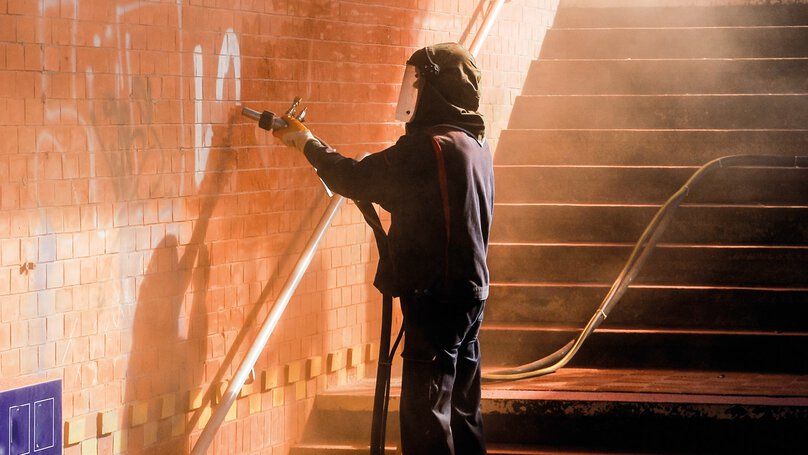
Required extensively in the construction sector, sandblasting is used to change the appearance or condition of a surface. From cleaning graffiti off buildings, to priming a surface for further processes like painting, it is favoured for its uniform results.
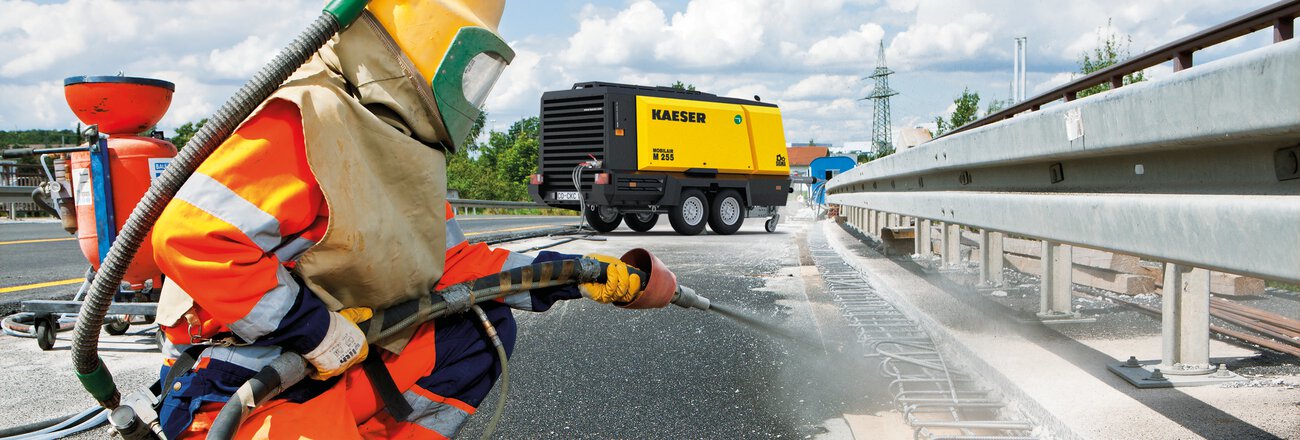
The process relies on high-pressure compressed air to propel a stream of tiny abrasive beads through a nozzle at high speed, which an operator manually points towards the blasting surface. The repeated force with which the beads hit the surface erodes unwanted material like paint or rust, generating a uniform surface finish.
This process requires a constant supply of cool, condensate-free, and technically oil-free compressed air: moisture in the compressed air can impact equipment performance, while oil can contaminate the surface being blasted. In addition, quality sandblasting results depend largely on the compressor consistently meeting the sandblasting equipment’s compressed air pressure and airflow requirements. This impacts for one, the force with which the beads leave the nozzle and therefore the consistency of results and overall productivity.
Sandblasting is also used for surface cleaning and preparation in many other market sectors

When traditional abrasive methods would be too harsh, dry ice blasting is typically used. This non-abrasive and non-corrosive dry surface cleaning method is often used in the construction sector for restoration and remediation projects. This could be restoring surfaces in historical buildings, to removing indoor mold spores or smoke damage caused by a flood or fire.
Dry ice blasting uses small dry ice pellets as the cleaning media. While the process is very similar to conventional sandblasting, the compressed air requirements are different. Dry ice blasting typically requires higher pressure, and air treatment is a mandatory requirement for certain dry ice blasting applications, such as those found in other market sectors like the food and beverage industry.
Dry ice blasting is also used for surface cleaning and preparation in many other market sectors.
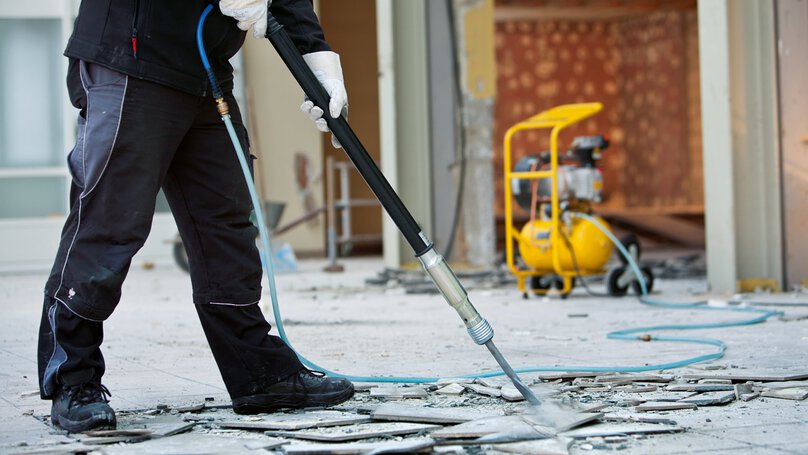
Compressed air is often required in renovation and refurbishment work to power air lances and air scalers used to strip internal or external floors, removing unwanted vinyl flooring, tiles, or even concrete.
Air lances are typically used to remove vinyl flooring that has been glued to concrete floors. Once a small hole has been cut into the vinyl, the air lance is inserted and compressed air is blown in. The pressure loosens the vinyl, lifting it away from the adhesive, and making it quick and easy to remove it from the concrete floor. Air lances generally demand high airflow.
Air scalers are commonly used to chip and scrape away tiles, tile adhesive and concrete. Compressed air powers the air scaler’s chisel or hammering action, providing the force required for the operator to make rapid and repetitive strikes with the air scaler against a surface.
For both tools and for optimum results, the compressor must consistently deliver the airflow at the pressure required. As continuous operation may be necessary - especially for air scalers - the compressor’s duty cycle must be able to maintain output, without overheating or losing pressure.

Pneumatic sanding and grinding tools rely on compressed air to operate. Whether it be for sanding screed to smoothing drywall, these heavy-duty tools aid in the sanding, grinding and polishing of various surfaces in the construction sector.
The compressed air demand can be as diverse as the sanding and grinding equipment being used. The compressor must therefore meet the most varied compressed air requirements. In general, pneumatic sanding and grinding machines require clean and dry compressed air.
KAESER solutions for Surface Preparation and Cleaning Applications in Construction
Exceptionally versatile, KAESER portable compressors deliver a dependable, continuous supply of compressed air, with a wide range of compressed air treatment options available.MOBILAIR portable compressors - dependable, durable, efficient
With a multitude of available equipment options, MOBILAIR portable compressors can easily meet the compressed air requirements of blasting applications - whatever the application size or type of media being used. Options available include compressed air treatment components such as: compressed air aftercooler, centrifugal separator and filters, which ensure the requirements for cool, condensate-free, and technically oil-free compressed air can be met. MOBILAIR portable compressors are designed and manufactured to deliver a reliable and efficient supply of compressed air, made with heavy-duty, continuous operation applications like blasting in mind.
Portable reciprocating trades compressors - reliable & versatile
The PREMIUM COMPACT and the i.Comp 3 series reciprocating compressors are both great choices for stripping floors using compressed air lances or scalers. Moreover, they are the ideal choice for all interior construction work that requires a constant supply of compressed air, such as sanding or grinding.
Made in Germany - KAESER’s commercial grade trades compressors provide exceptional reliability and performance. High quality materials and meticulous assembly guarantee maximum compressed air availability and long service life.
FAQs
Air pressure (bar/psi) determines the force of the abrasive impact. Higher compressor pressure ensures more kinetic energy is transferred to the abrasive, making blasting more efficient. However, pressure losses can occur throughout the system, so it’s important to optimise the compressor settings to maintain sufficient pressure at the nozzle.
Airflow (measured in m3 /min, cfm, or l/s) identifies how much compressed air is available to carry abrasive particles. Insufficient airflow can cause pressure drops, leading to slower blasting speeds and uneven surface preparation. It’s important to always ensure your compressor meets the required airflow for your nozzle size and blasting setup.
Both air pressure and airflow must be balanced - too little airflow can’t sustain pressure, while too little air pressure weakens the impact force.
The efficiency of a compressor is heavily influenced by the design of the blast machine, particularly the size and condition of the nozzle. A properly sized compressor must supply enough airflow (m3/min, cfm, or l/s) to match the nozzle’s air consumption while maintaining the recommended pressure at the nozzle, typically between 6.2 - 8.6 bar(g) / 90 and 125 psi(g).
Larger nozzles require more airflow, and as nozzles wear over time, their orifice expands, increasing air consumption. If the compressor isn’t sized correctly, efficiency drops due to excessive power consumption or inadequate airflow. Low pressure can indicate insufficient airflow, often caused by nozzle wear, system leaks, or additional air users. Simply increasing pressure won’t solve airflow deficiencies.
To optimise compressor efficiency, it's important to regularly inspect and replace worn nozzles, otherwise, increasing compressor size (along with dryers, filters, and hoses) may become necessary, leading to higher fuel or electricity costs. By maintaining nozzles and preventing unnecessary air loss, a blast machine can operate efficiently without overloading the compressor.
Moisture in the compressed air or excessive oil carryover can cause abrasive media to clog and reduce blasting efficiency.
To address such concerns, KAESER offers its System A compressed air treatment package. Delivering cool, condensate-free compressed air, it helps to prevent this issue - especially in humid environments. Alternatively, where technically oil-free compressed air is required at the blasting nozzle, KAESER offers the System F compressed air treatment package. This package combines compressed air aftercooler, centrifugal separator and filtration for cool, condensate-free compressed air, free from contaminant particles.
Suction volume - also known as intake volume - refers to the volume of air a compressor draws in at atmospheric pressure. Volume flow (FAD) is the actual usable compressed air at the required pressure that is available at the outlet after compression. Both are expressed per unit of time.
As air gets compressed, the actual available volume flow will always be lower than the suction volume. Therefore referring to the suction volume rather than the volume flow when sizing a compressor for your pneumatic tools can lead to underestimating the air delivery. Ensuring the right flow rate (volume flow) at a required pressure is crucial for the safe operation and proper performance of the respective tools.