
Should a dryer be installed before or after the air receiver?
In designing a compressed air station one of the most common questions we get asked is - should the dryer be installed before or after the air receiver? There is actually no right or wrong answer as each layout has its own set of benefits and drawbacks. In this blog post we discuss the pros and cons of both options and provide some examples of when each configuration may be most beneficial.
It’s a question commonly asked when an end user starts to design their compressed air station - should the dryer be installed before or after the air receiver? Dryer installation downstream of (after) the air receiver has always been the traditional method, with dryer installation upstream of (before) the air receiver being the more modern approach. Nevertheless, each method has its own merits and drawbacks and each may be better suited to certain applications.
Dryer installation downstream of (after) the air receiver
A more traditional approach
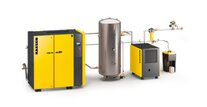
Designing a compressed air station - should the dryer be installed before or after the air receiver? Here an example of downstream installation
So what are the advantages of installing a dryer downstream of (after) the air receiver?
- 70% of the condensate is separated in the air receiver or centrifugal separator. This means less load on the compressed air treatment and dryer equipment which will ultimately lead to a longer service life.
- There will be a lower compressed air inlet temperature in the dryer than in the case of installation upstream of the compressed air receiver. As a result it may not be necessary to oversize the compressed air treatment components as much. This would reduce the initial investment and ongoing running costs of a larger dryer.
- The dryer can be set up for partial flow if appropriate. This opens up the possibility to reduce the required dryer size if wet air is used on site directly from a wet air receiver. Being able to opt for a smaller dryer would not only reduce the initial investment required, but also the subsequent energy costs.
- Condensate will form in the air receiver. This could lead to internal corrosion over time which would shorten the useful life of the air receiver.
- The dryer can be overloaded when large volumes of air are suddenly drawn from the compressed air reservoir which could compromise air quality.
- Dryer selection can be difficult because of potentially large fluctuations in flow rate. And, if the dryer selection is not based on known site air demands, the air quality could therefore vary as a result.
- Potentially higher costs could be incurred due to the need for a larger dryer. The larger the dryer - the higher the associated investment and running costs will be.
Dryer installation upstream of (before) the air receiver
A more modern approach
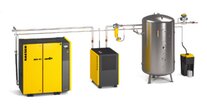
Designing a compressed air station - should the dryer be installed before or after the air receiver? Here an example of upstream installation
And, what are the advantages of installing a dryer upstream of (before) the air receiver?
- Treated air is stored in the air receiver and therefore ready for instant / fluctuating air demands.
- As dryer air is stored in the air receiver there will be no condensate precipitation. This eliminates the chance of corrosion forming inside the air receiver thereby extending its service- and useful- life.
- The compressor flow rate is the maximum air volume for the refrigeration dryer, which means there is no overload. Dryer sizing is much easier to determine when the air demand is known and oversizing is not necessarily required. This creates many benefits; it reduces capital- and running- costs and it ensures constant and predictable air quality.
- Better buffering of consumption peaks is possible as the treated air is stored in the air receiver and is therefore ready for instant varying/fluctuating air demands.
- The dryer air inlet temperature is somewhat higher than it would be downstream of the receiver. This means that the dryers performance may drop on hotter days. As a result the dryer may need to be oversized. And, the larger the dryer - the higher the investment- and running- costs will be.
- Furthermore, condensate must be precipitated upstream of the dryer. This means that a centrifugal separator will be needed before the dryer (in other words creating additional capital outlay -> operating costs and maintenance costs).
Conclusion
Ultimately the decision of installing the dryer before or after the air receiver will depend on the application. For example, if you wanted “wet-untreated air” for an application - downstream installation would be the better option as you could take it out of the air receiver before the dryer. Therefore the dryer could be smaller (which reduces the capital equipment outlay and associated energy costs).
An example where upstream installation may be more beneficial would be where you wanted to store dry air for peak load. This configuration would be more beneficial as the air receiver would store the already dried and treated air.
Seeking expert compressed air advice would be the best way to determine which configuration would be most beneficial to meet your specific application and compressed air demand requirements.
Last updated: September 2020
Learn more
Our dedicated in-house engineering team are ready to assist you in renovating your existing - or designing a completely new - compressed air station. KAESER has highly effective tools for the planning of new compressed air supply systems and for the optimisation of existing ones. Our engineering team can provide full on-site compressed air assessments which ultimately allow them to determine the best system solution for your individual air application.
To discuss your compressed air requirements just phone 0800 447 820 or send us an email and we will get back to you.