Compressed air applications in Agriculture
Crop Production
Compressed air applications are numerous within crop production, ranging from managing soil health with air lances (aeration, loosening, and excavation) to operating precise greenhouse and irrigation system controls. These controls are responsible for tasks like the controlled dosing of water and nutrients, and the efficient opening and closing of greenhouse vents. Additionally, compressed air forms an important maintenance task when it comes to winterising outdoor irrigation lines.
Despite the differing compressed air requirements across these applications, the requirement for highly robust, reliable, and efficient compressed air equipment remains the same. This reliability is crucial for the effective management of finite resources like water, contributing to the overall energy- and cost- efficiency, and sustainability of modern agricultural practices.
The most typical crop production applications that require compressed air include:
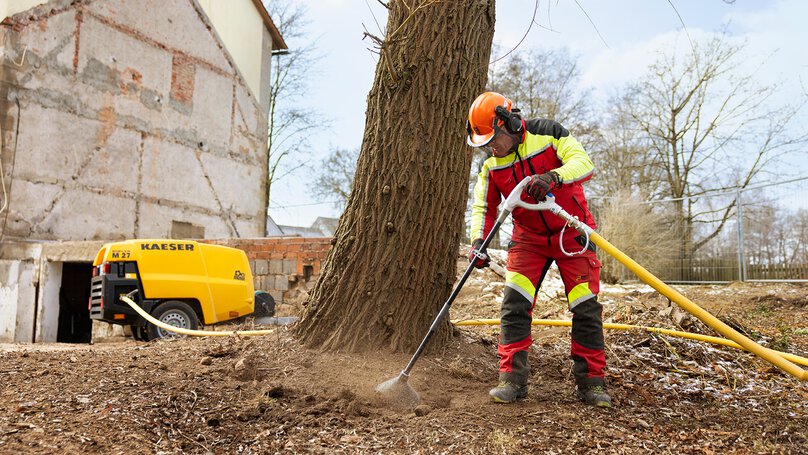
For optimum effectiveness and efficiency, the compressed air requirements of the air lance’s nozzle should be precisely matched.
An air lance is an efficient and non-invasive tool used by arborists and landscapers to aerate and loosen compacted soil. This method works by injecting a high-pressure stream of compressed air into the ground. The force of the compressed air creates fractures within the soil, which breaks up dense layers and restores crucial pore spaces without harming established root systems. Beyond loosening the soil, this method allows for the targeted delivery of feed nutrients and mix-ins like perlite directly into the root zone to improve long-term aeration and drainage.
Using an air lance for soil aeration and loosening is also an emerging practice in modern agriculture, particularly for perennial crops like those in vineyards and orchards. It provides a low-impact alternative to large-scale tilling, which could otherwise harm the plant’s established root systems. An air lance, by contrast, offers a targeted method for in-field soil management, helping to combat compaction. This technique ultimately aims to improve water infiltration, nutrient absorption, and the long-term health and productivity of the crop.
Air lances for soil aeration, loosening, and excavation, require a portable screw compressor solution, capable of meeting this application’s continuous demand for compressed air. Precisely matching the compressed air requirements of the air lance’s nozzle to the compressor is essential for efficient and safe operation. Exceeding the pressure requirement, for example, can reduce the air lance’s effectiveness while increasing energy consumption. The hose length and diameter are also important considerations when selecting a suitable compressor for this application. A smaller-diameter hose can drastically reduce the pressure delivered to the air lance, minimising its effectiveness, while using a longer hoses can lead to pressure loss, which means a compressor with sufficient capacity would be required to compensate.

Pneumatic controls are often employed to open and close greenhouse roof vents.
Greenhouse controls monitor and adjust the environment to create ideal growing conditions. These systems frequently manage crucial climate mechanisms, such as opening and closing roof and side vents, to regulate temperature, humidity, and airflow. A reliable supply of compressed air is essential when these controls are operated by pneumatic actuators.
To move the vents, a control system will send an electrical signal to a solenoid valve, which opens to allow compressed air to flow to the pneumatic actuators. These actuators then convert the compressed air into a physical force to either push or pull the vents open or closed.
Greenhouse farming is one of the most energy-intensive forms of agriculture. While heating can account for the majority of this expense, every efficiency gain helps in minimising energy costs and supporting sustainable farming practices. A dependable and efficient compressed air supply is therefore essential for these operations. For systems with low-volume, intermittent air requirements, reciprocating compressors are often the ideal solution, as they are designed to efficiently handle frequent start-stop cycles. Conversely, rotary screw compressors are best suited for greenhouses with continuous air demands.
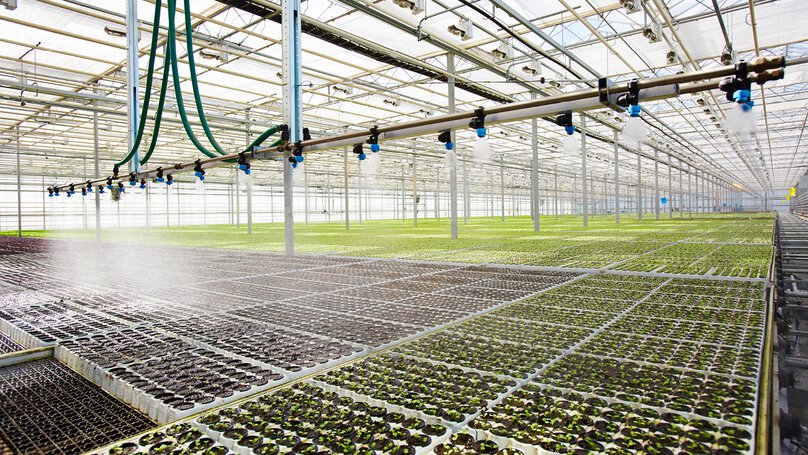
Modern, large-scale greenhouse and field operations often rely on automated control valves to irrigate and fertigate crops.
Sophisticated irrigation systems are used to precisely manage the delivery of water and nutrients to greenhouse and field crops, helping to maximise yields and improve soil health, ultimately protecting finite resources.
Irrigation systems require reliable mechanisms for flow regulation. Modern, large-scale operations (including both greenhouse and field) rely heavily on automated control valves to ensure water and nutrients are directed to the correct zone at the correct time. These zone valves can be actuated by compressed air providing the pneumatic force necessary to quickly and reliably open and close the large valves against the water flow. Especially in humid environments like greenhouses, pneumatic valves offer a robust solution.
The use of compressed air is also common in field applications, such as when swing arms are incorporated into Variable Rate Irrigation (VRI) systems. These centre-pivot components are specifically designed to manage corners or irregular field shapes. While the main VRI system changes the water application rate simply by adjusting the pivot’s travel speed, the swing arm must cover complex corner zones, requiring its individual sprinklers to be dynamically switched on and off at high speed. To achieve this precision, these arms often rely on a compressor to control the valves on the individual sprinklers. This pneumatic control is critical because it provides the high mechanical force necessary to quickly and reliably open and close the valves against the system's inherent water pressure.
Sophisticated irrigation systems must operate reliably in harsh agricultural environments to ensure they are maximising crop health and minimising resource waste. Robust and reliable compressed air equipment is therefore essential to efficiently meet the typically intermittent operational demands of irrigation systems.
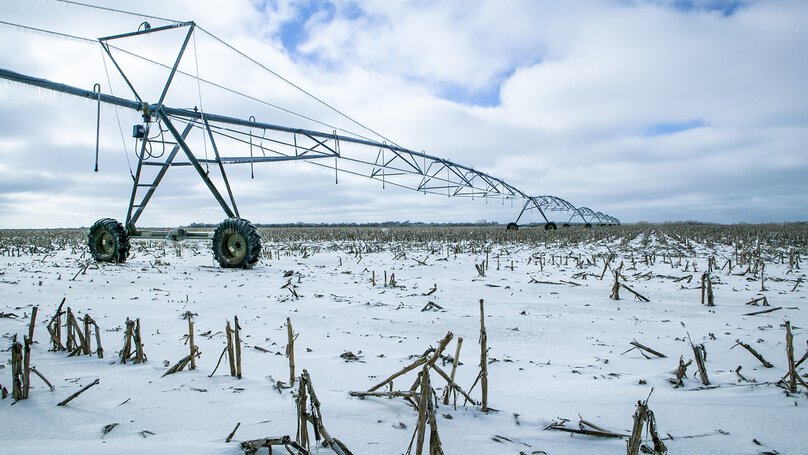
Compressed air is required when the blow-out method is employed to winterise outdoor irrigation systems
Winterisation of outdoor irrigation systems is an important maintenance task in cold climates. It is performed at the end of the growing season to clear water out of the system, thereby protecting the integrity of irrigation lines from freezing damage during the winter months. The blow-out method is commonly employed. Here, compressed air is injected into the piping network zone-by-zone after the water supply is isolated. The compressed air forms a slug behind the water column and physically pushes the water out through the sprinkler heads. The compressed air supply is maintained until only a fine mist remains, indicating the bulk of the standing water has been removed.
In order to successfully clear water from irrigation lines, the compressed air supply must deliver both the correct pressure and flow rate. The air pressure must be precisely controlled to push the water out without rupturing pipes, valves, or seals. At the same time, the compressor must deliver a sufficiently high flow rate to generate a continuous air slug capable of efficiently clearing the residual water from the pipes.
The blow-out method is also used by landscapers to winterise commercial and residential outdoor sprinkler systems. While the underlying principles remain the same, the technical requirements for the compressed air supply are highly variable depending on the system's size. For example, the required flow rate (m³/min / CFM) is generally significantly lower. Nevertheless, the air pressure must remain tightly controlled for all pipe materials to prevent component ruptures, making the correct combination of regulated pressure and adequate flow rate essential for reliable winterisation across all applications.
KAESER solutions for crop production
Flexibility in the field
For all outdoor crop production requirements - from winterising large irrigation systems and sprinkler lines to providing compressed air for soil aeration and excavation - KAESER offers highly flexible portable compressed air solutions. Designed for direct in-situ use, they ensure compressed air is available exactly where it is needed. The range includes the powerful MOBILAIR portable screw compressors, powered by either a combustion engine or electric motor, alongside the robust i.Comp, CLASSIC, and PREMIUM series portable reciprocating compressors. The inclusion of essential compressed air treatment options ensures the required air quality can be effortlessly achieved. Depending on the demands of the specific application, KAESER provides compressed air treatment solutions up to technically oil-free air.
Learn more:
Stationary efficiency for greenhouse and irrigation control
The operational requirements of greenhouse and irrigation system controls in fixed agricultural infrastructure can be efficiently met by KAESER’s robust range of stationary rotary screw and reciprocating compressors.
The optimal solution is determined by the compressed air demand of the application: rotary screw compressors are the preferred choice for facilities with higher, more continuous airflow demands. Conversely, reciprocating compressors (such as the EUROCOMP series) are ideal for low-volume, highly intermittent needs.
KAESER compressed air treatment solutions can additionally be added to meet the compressed air quality demands of the specific application.
Learn more:
Let our compressed air experts assist you in selecting the right compressed air solution for your crop production needs.
FAQs
No, KAESER does not manufacture air lances. Instead, we manufacture a comprehensive range of portable screw compressor solutions designed to meet the specific requirements of all air lances used for soil aeration, loosening, and excavation. Our high-performance MOBILAIR portable compressors provide the high-volume, consistent airflow necessary to power these tools effectively across a variety of agricultural and civil engineering applications.
Selecting the optimum compressed air supply is essential for ensuring your equipment operates at peak performance. Our experts can guide you in selecting the ideal compressor solution based on the technical specifications of your air lance to ensure your soil management project is both efficient and dependable.
Need help selecting the right compressor for your air lance?
Most standard reciprocating compressors are not designed for continuous operation; they are engineered for intermittent use. If your application requires a continuous supply of compressed air - or compressed air over extended periods - then a rotary screw compressor would be the optimal solution.
Selecting the right compressor starts with understanding your greenhouse control system’s air demand patterns, though air quality and energy efficiency are equally important. For systems with low-volume, intermittent requirements, reciprocating compressors are often ideal. For applications with intermittent larger volume requirements, adding an air receiver provides the buffer capacity needed to satisfy short periods of high demand while maintaining stable system pressure.
In contrast, rotary screw compressors are the most efficient option for greenhouses with continuous air demands. Engineered for a 100% allowable duty cycle, these compressors provide a dependable and consistent supply for operations where pneumatic controls are in constant use.
Need help selecting the optimum compressed air solution for your greenhouse control system?