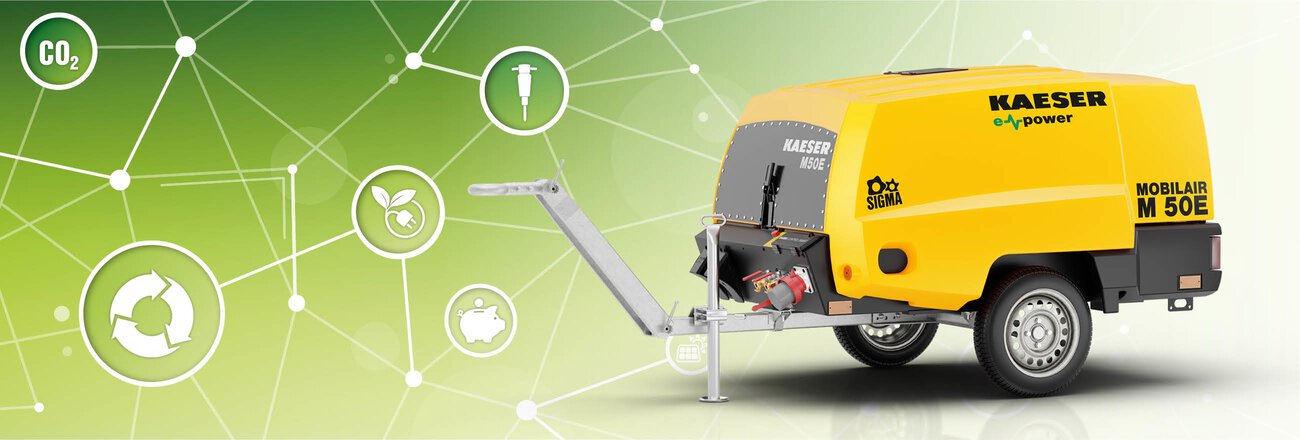
Intelligent efficiency on the construction site: How the MOBILAIR M 50E SFC with frequency converter is revolutionising portable compressed air
The new electrically driven MOBILAIR M 50E SFC from KAESER brings state-of-the-art frequency converter technology directly to the construction site. The result: up to 30 per cent lower energy consumption, quieter operation, longer service life, and maximum flexibility – a genuine step forward for efficient, sustainable construction sites. In this blog post, you will discover how variable-speed control is taking portable compressed air generation to the next level.
Transformation on the construction site: Greater efficiency, lower consumption
Construction sites today face new challenges: Energy efficiency, sustainability, and operator comfort have long since become central themes – not only for environmental reasons, but also because they directly determine costs, productivity, and competitiveness.
Portable compressed air systems are in use on almost every construction site – they power tools, supply machinery, and ensure smooth operation. At the same time, they need to operate reliably under ever-changing conditions: sometimes in continuous operation, sometimes at idle, and often with heavily fluctuating compressed air demand.
To meet these requirements, more than pure power is needed. It requires intelligent control technology that adapts flexibly and conserves resources.
From marathon runner to smart thinker: Frequency converters are transforming compressor technology
Traditionally, many portable compressors operated according to a simple principle: on or off, full load or idle. This means the motor often runs at full speed – even when only a fraction of the actual power is required. The result: unnecessarily high energy consumption, increased wear, and excessive noise.
The use of modern frequency converters fundamentally changes this principle. A frequency converter provides stepless control of the electric motor speed, adjusting it in real time to meet actual compressed air demand. If demand is low, motor speed is reduced - if demand increases, it is automatically increased again.
This may sound like a minor technical adjustment, but in practice, it has an enormous impact: The compressor operates more energy-efficiently, quietly, and reliably, while providing a more consistent and precise compressed air supply.
Technology with clear practical advantages
What has long been standard in stationary industrial applications is now making its way into portable use on construction sites – and for good reason. A compressor with a frequency converter combines technical intelligence with robust everyday performance. It enables soft starts without high start-up currents, protecting the power grid or external battery storage, reducing wear, and noticeably lowering energy consumption.
For users, this means: greater efficiency, more flexibility, and lower operating costs - exactly the qualities that increasingly make the difference on modern construction sites.
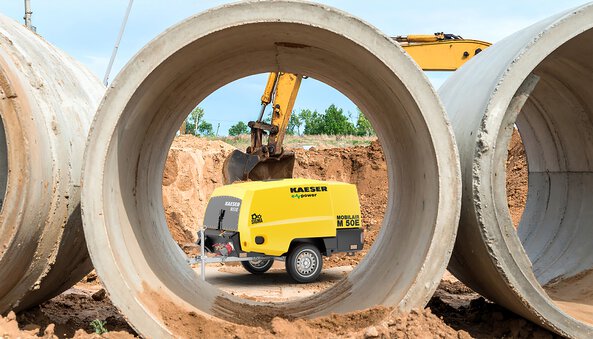
The MOBILAIR M 50E SFC combines modern control technology with energy-efficient, quiet compressed air production – ideal for the requirements of today's and tomorrow's construction sites.
The MOBILAIR M 50E SFC: efficiency, intelligence, and performance in harmony
With the electric MOBILAIR M 50E SFC, KAESER brings the energy efficiency of the future directly to the construction site – demonstrating how intelligent control technology saves energy, costs, and resources. This emission-free compressor precisely adjusts its performance to actual demand, operating reliably, quietly, and efficiently, thereby setting new benchmarks for sustainability and cost-effectiveness in portable applications.
Key benefits at a glance
- Energy efficiency and savings
The greatest advantage is clear: the MOBILAIR M 50E SFC consumes significantly less energy. Thanks to variable-speed control, the frequency converter adjusts motor speed precisely to match current air demand. When only a small amount of compressed air is required, the compressor runs at a correspondingly lower speed – saving up to 30 per cent in energy compared with conventional units.
A further benefit: the compressor avoids unnecessary idling times. Where conventional models often continue to run even when no air is being drawn, the M 50E SFC automatically reduces motor speed – making it efficient, quiet, and resource-friendly.
- Significantly lower noise levels
Especially on noise-sensitive construction sites, in city centres, or during night work, every decibel counts. Thanks to variable speed, the M 50E SFC runs considerably more quietly at partial load than a compressor operating at full load. This means: more pleasant working conditions and better compliance with noise protection regulations – an advantage not to be underestimated for many locations.
- Operation via external battery storage systems
A further practical advantage is the soft-start capability. The frequency converter ensures that the motor starts smoothly and without high start-up currents. This protects the construction site power grid, prevents voltage peaks, and extends the service life of the electrical infrastructure. Furthermore, this technology enables operation via external battery storage systems – a decisive step toward the sustainable, grid-independent construction site.
- Precise pressure control and consistent process quality
Everyday life on a construction site means fluctuating air demand. This is where the M 50E SFC truly shines: thanks to the variable speed, the compressor maintains the desired pressure constantly and precisely, even when demand changes. This not only ensures consistent tool operation and higher efficiency for connected equipment but also provides greater process reliability. Moreover, as is familiar from the diesel-powered MOBILAIR models, the proven pV control can be used. This allows the working pressure to be flexibly adjusted between 6 and 11 bar, depending on the application. As a result, the compressor remains future-proof and offers power reserves, for example, for longer hose lines or new tools.
- Less wear, longer service life
The M 50E SFC is particularly kind to its components. Through the soft start, reduced speeds at partial load, and smooth load changes, the mechanical stress on the motor, bearings, and airend is significantly reduced. This means: less wear, lower maintenance requirements, and an overall longer service life for the components – a clear benefit for cost-effectiveness.
- Environmental benefits through efficiency and noise protection
Lower energy consumption automatically means: fewer CO₂ emissions. This is where the M 50E SFC makes an active contribution to environmental protection. Moreover, quieter operation reduces noise pollution in the surrounding area – a win for both people and the environment. This is a decisive factor, especially on construction sites in urban areas or sensitive zones (e.g., near hospitals or schools).
- Industrial application: the ideal backup system for outages, maintenance, or production peaks
The M 50E SFC is not only a construction site specialist, it also excels in industrial environments as a flexible standby solution. If a stationary compressed air system breaks down, a maintenance interval is due, or a short-term increase in air demand arises, the M 50E SFC can be deployed quickly and reliably. With precise pressure adjustment, variable speed, and efficient operation, it handles peak loads with ease – ensuring maximum operational reliability and continuous process stability in production.
Conclusion: a smart step into the future of portable compressed air
The MOBILAIR M 50E SFC impressively demonstrates how modern control technology is revolutionising portable compressed air production. Combining intelligent speed control, high energy efficiency, and low noise levels, it delivers exactly what today’s and tomorrow’s construction sites demand.
Lower energy consumption, reduced noise, and less wear – ensuring greater efficiency, flexibility, and reliability.
In short: The M 50E SFC makes portable compressed air smarter – and sets new standards for practical application.